In the critical early years of brain development, group size directly impacts the quality of care. Families comparing licensed home daycare providers with larger centre‑based programs in Toronto often find that smaller groups deliver more consistent caregiver attention and stronger developmental outcomes. With CWELCC and municipal subsidies now making small‑group care affordable, licensed home child care has become a practical, research‑supported choice across the GTA.
What the Research Actually Shows
A 2022 systematic review published through the Campbell Collaboration looked specifically at adult-to-child ratios and group size in early childhood settings. The honest finding: high-quality, current research on this exact question is surprisingly thin, and results vary by study. That said, the review found tentative support that fewer children per adult and smaller group sizes lead to better “process quality” — meaning more positive adult-child interaction, less coercive discipline, and more prosocial behaviour between children.
One of the most cited pieces of evidence is older but notable: the U.S. National Day Care Study, which followed 64 centres in the late 1970s and found that children aged 3 to 5 in smaller groups showed more positive development and behaviour, even when the ratio of adults to children stayed the same. In other words, group size on its own seemed to matter, not just how many adults were in the room.
None of this means larger, well-run centres can’t provide excellent care — many do. But it does mean that when a home daycare provider offers a genuinely small, consistent group, there’s a real, researched basis for why that setting can support a young child’s social and emotional development, not just parental preference.
Why Home Daycare Naturally Delivers Small Group Care
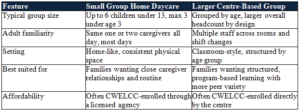
In Ontario, this isn’t a marketing claim — it’s built into the licensing rules. A licensed home child care provider can care for a maximum of six children under 13, with no more than three under age three. That cap exists specifically to keep ratios manageable in a home setting, which naturally produces the smaller-group conditions the research points to.
- Children typically see the same one or two caregivers each day, rather than rotating through multiple staff across shift changes.
- Daily routines stay consistent — same nap space, same play areas, same schedule — which supports the kind of predictability young children respond well to.
- Mixed-age groupings in a home setting mean younger children get regular exposure to older peers, and older children get natural opportunities to help and lead.
Small Group Home Daycare vs. Larger Centre-Based Group
How Government Funded Childcare Makes Small-Group Care More Accessible
Cost used to be the biggest barrier to choosing a licensed home daycare provider over a larger centre. That’s changed significantly since Ontario joined the Canada-Wide Early Learning and Child Care (CWELCC) system. Licensed home child care agencies can enroll in CWELCC just like centres, meaning families can access the same $22/day fee cap through a small home-based program as they would through a larger centre. Families who also qualify for the municipal child care fee subsidy can reduce costs further, which has made small-group, government funded childcare a realistic option for many more households than it was a few years ago.
What to Look for When Choosing a Small-Group Provider
- Confirm the provider is licensed and operating through a recognized licensed home child care agency, not informally.
- Ask directly how many children, and what ages, are in care on a typical day — group composition can shift week to week.
- Check whether the agency is CWELCC-enrolled, and ask how that affects your daily fee.
- Ask about the agency’s home-visit schedule and how often a licensing representative checks in on the provider.
- Request references or reviews from current or past families, the same way you would for a larger centre.
For Providers: Why Join a Childcare Agency
If you’re an experienced caregiver considering becoming a home daycare provider, choosing to join a childcare agency rather than operating informally comes with real advantages. An agency handles the licensing relationship with the ministry, connects you with families actively searching for small-group care, and provides ongoing support through regular home visits and policy guidance. For many providers, that support is what makes running a compliant, sustainable small-group program possible without having to navigate licensing requirements alone.
Common Misconceptions
- “Smaller always means less structured.” Many small-group home daycare providers run just as structured a daily routine as a centre — smaller doesn’t mean unplanned.
- “Centre-based care is automatically higher quality.” Quality depends far more on caregiver consistency, training, and ratios than on the size of the building.
- “Home daycare isn’t really licensed.” A licensed home child care provider operates under the same Child Care and Early Years Act requirements as a centre, just through an agency structure.
Key Takeaways
- Research on group size is still developing, but current evidence tentatively supports smaller groups for better adult-child interaction and child behaviour.
- Ontario’s licensing rules cap licensed home child care at 6 children (max 3 under age 3), which naturally creates small-group conditions.
- CWELCC and municipal fee subsidies have made small-group, government funded childcare more affordable than it was a few years ago.
- Parents should verify licensing and CWELCC status directly, regardless of whether they’re considering a home provider or a centre.
- Providers considering opening a small-group program often benefit from choosing to join a childcare agency rather than operating independently.
Small group sizes aren’t just a preference — there’s a real, if still-developing, research base behind why fewer children per caregiver supports early development. If you’re comparing a home daycare provider against a larger daycare services Toronto centre, ask directly about group size, licensing, and CWELCC status before making a decision. And if you’re a caregiver exploring this path yourself, reach out to a licensed childcare agency to learn what joining a network of providers actually involves.