
Ontario’s childcare waitlists haven’t grown because something broke. They’ve grown because the $10-a-day program worked almost too well on one side of the equation: fees dropped fast enough that far more families could suddenly afford licensed care, while the number of new spaces and trained educators didn’t grow at the same pace. If you’re staring down a years-long wait for a spot in Toronto or anywhere else in the province, here’s what’s actually driving it, and what you can realistically do while you wait.
The Core Reason: Demand Grew Faster Than Supply
When Ontario signed onto the Canada-Wide Early Learning and Child Care agreement in 2022, fees for participating programs started dropping sharply, eventually landing at an average of $19/day with a $22/day cap. That made licensed care realistic for a huge number of families who’d been priced out or were using informal arrangements instead Demand rose immediately. New licensed spaces take far longer to build and staff than it takes a family to decide they can finally afford to apply — and that gap is the waitlist you’re seeing today.
The Numbers Behind the Backlog
- Niagara Region’s waitlist grew 76% in the two years after Ontario joined the national program, with particularly sharp increases for toddlers and preschoolers.
- Ontario’s Auditor General has estimated the province needs roughly 10,000 more Registered Early Childhood Educators to staff the spaces CWELCC is meant to fund.
- An Auditor General review also found more than 21,000 families with an approved fee subsidy had no space to actually use it — meaning funding approval alone doesn’t guarantee a seat.
- Ontario is required under the CWELCC agreement to create 86,000 new licensed spaces. The deadline has been formally extended to March 2027.
- Advocacy groups tracking the sector put the province’s space shortfall well above 200,000 when measured against the number of children who could realistically use licensed care.
What’s Changing Going Forward
On September 29, 2026, the federal and Ontario governments announced a four-year extension of the CWELCC agreement, securing close to $12 billion in federal funding from March 2027 through March 2031. That’s good news for the program’s long-term survival, but it comes with an important catch for parents: Ontario has only committed to holding fees at the current $19/day average, $22/day cap, until June 30, 2027. What happens to fees after that date, and how much new space creation gets funded, is still being negotiated between the two governments?
Why Some Neighbourhoods Feel It Worse Than Others
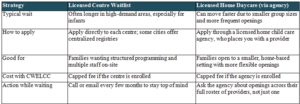
Wait times vary enormously by location and age group. Infant spaces are consistently the hardest to find, because provincial staffing ratios are mandatory. Even fully licensed centres can only offer a limited number of infant spots under these regulations. Dense, high-demand areas — a daycare downtown Toronto search makes this obvious fast — tend to have longer waits than smaller towns, simply because there are more families competing for a similar number of licensed spots. Licensed home daycare in Toronto and other urban centres has become a popular alternative precisely because smaller provider networks can sometimes offer an opening faster than a large centre with a years-long list.
Centre Waitlist vs. Home Daycare Waitlist: What Actually Moves Faster
What Parents Can Actually Do About It
- Apply as early as possible — many families now apply to waitlists while still pregnant, since some lists realistically take over a year to clear.
- Apply broadly, not narrowly. Families who apply to ten or more centres and home daycare providers have a meaningfully better shot at getting a usable offer when they need one.
- Families must apply separately for the fee subsidy through their municipality. Approval is income‑tested and does not depend on already having a confirmed space.
- Check centralized registries where they exist. Some municipalities run a single waitlist system across multiple providers, which can simplify tracking compared to applying individually everywhere.
- Stay in regular contact. A short call or email every couple of months keeps your family visible to staff when a spot does open.
- Consider a licensed home daycare provider through an agency, not just large centres — smaller programs sometimes have more frequent turnover in their spots.
Common Mistakes Parents Make While Waiting
- Applying to only one or two centres. Given current wait times, this is the single biggest reason families end up without care when they need it.
- Assuming CWELCC status means a shorter wait. Lower fees are exactly what drove demand up, so CWELCC-enrolled programs often have the longest lists, not the shortest.
- Waiting to apply for the fee subsidy until a space is confirmed. Processing takes time, and it’s a separate queue from the daycare’s own waitlist.
- Overlooking home daycare options because they assume a home setting is less structured or less legitimate than a centre — a licensed provider through a recognized agency meets the same provincial standards.
Key Takeaways
- Waitlists grew because CWELCC made licensed care affordable to far more families faster than new spaces or educators could be added.
- Ontario’s 86,000-space target has been pushed to March 2027, and a new four-year funding extension only guarantees current fees until June 30, 2027.
- Infant spaces and dense urban areas like daycare downtown Toronto tend to have the longest waits.
- Applying early, applying broadly, and applying for the fee subsidy separately are the most effective things a family can control.
- Licensed home child care through an agency is a provincially regulated alternative to a large centre, and in some cases may offer faster openings
Conclusion
Ontario’s waitlist problem is a supply problem, not something any one family can out-plan their way around entirely. But applying early, casting a wide net across both centres and licensed home daycare providers, and getting your fee subsidy application in regardless of whether you’ve secured a spot yet are the moves that actually shorten your personal timeline. If you haven’t started applying yet and your child is under three, today is a good day to start.