Ontario doesn’t have a shortage of parents looking for care — it has a shortage of spaces. Recent Statistics Canada data found 31% of families with children under six were on a waitlist in 2025, the highest share on record, and Ontario’s Financial Accountability Office has projected the province could be short more than 220,000 child care spaces against demand. So when a specific daycare services Toronto or home day care Ontario provider has trouble filling seats, the cause usually isn’t the market. It’s something closer to home: reputation, communication, or how the program actually runs day to day.
The Demand Isn’t the Problem
With roughly 92% of licensed operators in Ontario now enrolled in CWELCC and fees capped at $22/day for participating programs, more families than ever can afford licensed care. That’s part of why waitlists have grown even as fees have dropped — lower costs pulled more families into the system than the province has spaces for. Against that backdrop, a program with open spots isn’t necessarily cheaper or worse. It’s often just less visible, less trusted, or harder to reach than its neighbours.
What Actually Separates Full Programs From Struggling Ones
A few patterns show up again and again when you look at why one licensed daycare or home daycare provider has a long waitlist while another down the street has open spots:
- Staff consistency. Ontario is short an estimated 10,000 early childhood educators, and turnover is one of the fastest ways a program loses parent trust. Families notice when the same educators aren’t there from term to term.
- Word of mouth. In tight-knit communities — this shows up constantly in York Region and midtown Toronto — a handful of parent reviews or a single bad pickup experience travels through group chats and community boards faster than any ad.
- Clear, current information. Programs that keep their CWELCC status, fee schedule, and open-spot availability up to date (on their website and with their local Children’s Services office) get found and get chosen. Programs still listing 2023 pricing lose trust immediately.
- Responsive communication. Parents comparing a childcare agency or a specific centre often decide based on how quickly and clearly their questions get answered, not just the tour itself.
- Flexible or transparent hours. Rigid drop-off and pickup windows without clear reasoning turn away working parents who have other options nearby.
- Location friction. A daycare two minutes off a commute route fills faster than one that adds ten minutes each way, even if the program itself is comparable.
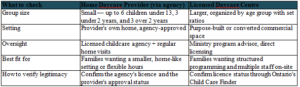
Home Daycare vs. Licensed Centre: What Parents Are Actually Comparing
What This Looks Like If You’re Searching Right Now
If you’re comparing a licensed daycare Toronto option against a home day care York Region provider, don’t assume open availability means lower quality. In a system this tight, it more often means the program simply hasn’t built the same visibility yet, or it’s newer and still growing its waitlist. What matters is whether the basics hold up: current licensing, a clear fee structure, and a provider or agency that answers questions directly instead of vaguely.
Common Mistakes Parents Make When Comparing Programs
- Assuming a long waitlist always means better quality. Sometimes it just means the program has been open longer or is better known — not that the care itself is superior.
- Not confirming licensing directly. A polished website doesn’t confirm a licence. Check the provider’s status through Ontario’s Child Care Finder before applying.
- Skipping questions about staff turnover. Ask directly how long the lead educators have been with the program.
- Ignoring fee subsidy and CWELCC eligibility. A program with open spots and CWELCC enrollment may end up cheaper than a full one that isn’t participating.
- Applying to only one program. Given current wait times, most families need to apply to several centres or providers at once to have a realistic shot at a spot when they need it.
Key Takeaways
- Ontario’s child care shortage means most struggling programs aren’t struggling because of low demand — visibility, trust, and communication are the real gaps.
- Staff turnover and inconsistent information are two of the fastest ways a program loses parent confidence.
- Open availability at a licensed daycare or home daycare provider isn’t automatically a red flag — verify licensing and fees directly rather than judging by waitlist length alone.
- Applying early and to multiple programs is now a practical necessity for most Ontario families, not just a suggestion.
The child care shortage in Ontario means nearly every licensed program has some demand behind it — the difference between a full waitlist and open spots usually comes down to trust, communication, and how well a provider or childcare agency manages the basics parents actually care about. If you’re currently comparing options in Toronto or York Region, start by confirming licensing status and current fees directly with each provider, then ask about staff consistency before you commit to a tour.