Whether you operate a child care centre or a licensed home child care agency, growing capacity in Ontario requires more than just enrolling new families. Every increase must go through a formal licensing revision under the Child Care Licensing System (CCLS). If your program is CWELCC‑enrolled, your municipality must also sign off before approval. This is where daycare consultants play a critical role—helping operators navigate compliance, staffing, and funding requirements so growth doesn’t come at the expense of quality.
Why Growth Isn’t Just a Business Decision
Under Ontario’s licensing system, your daycare license Ontario sets out a specific approved capacity — how many children, in which age categories, at which location. Increasing that number isn’t automatic. You have to submit a revision request through the Child Care Licensing System (CCLS), and the ministry reviews it against the same space, ratio, and staffing standards that applied when you first got licensed.
The CWELCC Wrinkle: Growth Isn’t Automatic
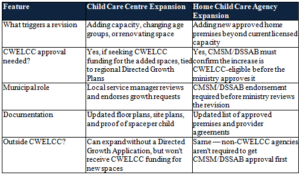
If your program is enrolled in CWELCC, capacity growth is tied to your region’s Directed Growth Plan — the province’s strategy for targeting new child care spaces toward areas of higher need. Before the ministry approves a capacity increase for a CWELCC-enrolled centre or home child care agency, your local Consolidated Municipal Service Manager (CMSM) or District Social Services Administration Board (DSSAB) has to confirm the new spaces are eligible for CWELCC funding. Licensees expanding outside the CWELCC system don’t need this municipal sign-off first, but they also won’t receive CWELCC funding for the added spaces — worth factoring in before you commit to a growth plan.
How a Licence Revision Actually Works
- Confirm whether your planned growth counts as a “revision” under CCLS — this includes adding capacity, changing age groups served, or adding new home child care premises for an agency.
- If you’re CWELCC-enrolled, contact your CMSM/DSSAB early to confirm the added spaces align with the region’s Directed Growth Plan before you invest in space or staff.
- Submit the revision request in CCLS, with new floor plans and site plans that demonstrate that the space continues to meet the required unobstructed floor space per child for each age category.
- Home child care agency growth requires submission of updated documentation for each new approved home premises and provider agreement.
- Wait for CMSM/DSSAB endorsement (if applicable) before the ministry proceeds with reviewing and processing the revision.
- Only operate at the new capacity once the revision is approved and reflected on your licence — operating above your approved capacity before approval is a compliance violation.
What Quality Risks Show Up When Operators Grow Too Fast
- Staffing can’t keep pace. Ontario is short an estimated 10,000 early childhood educators, and a rushed hire to hit a new ratio requirement often means a less experienced or less integrated team.
- Ratios and group sizes get stretched thin. Even a short-term staffing gap during a transition period can put a centre out of compliance with its own approved ratios.
- Space requirements get treated as a formality. The unobstructed floor space minimums per age category aren’t just paperwork — overcrowded rooms measurably reduce the quality of supervision and programming.
- Culture and consistency erode. Families choose a program partly for consistent caregivers and routines; rapid staff turnover during expansion undermines exactly what built the waitlist in the first place.
- Cash flow gets strained before revenue catches up. New space, renovations, and hiring costs are usually front-loaded well before a newly approved capacity is fully enrolled.
Centre Expansion vs. Home Child Care Agency Expansion
Capacity Planning Checklist Before You Apply for a Revision
- Confirm current staff-to-child ratios have room to absorb growth, or map out exactly who you need to hire and by when.
- Get written confirmation from your CMSM/DSSAB — new spaces can only be opened once funding and spots are formally approved under the region’s Directed Growth Plan.
- Update your floor plans and confirm space per child still meets O. Reg. 137/15 requirements before you submit.
- Create a realistic time schedule regarding hiring based on the present teacher shortage situation and not a best-case scenario.
- Review your program statement and parent handbook to confirm they still reflect the program accurately at the new scale.
- Model your cash flow assuming a gradual fill rate for new spaces, not immediate full enrollment.
When to Bring in Daycare Consulting Services
Daycare consulting services and day care consultant services are often most valuable at exactly this stage — not just at initial licensing. Growth touches licensing, staffing, municipal relationships, and space design all at once, and an experienced consultant who has guided other operators through a CCLS revision knows what documentation moves quickly and what typically gets sent back for clarification. This is also where licensing for home daycare agencies gets particularly nuanced, since every new approved premises needs its own documentation even under a single agency licence.
Key Takeaways
- Increasing your licensed capacity always requires a formal revision through CCLS, whether you operate a centre or a home child care agency.
- CWELCC-enrolled programs need CMSM/DSSAB confirmation that new spaces fit the region’s Directed Growth Plan before the ministry approves growth.
- The biggest quality risks in fast growth are staffing shortfalls, ratio strain, and space that no longer meets per-child requirements.
- A realistic hiring and cash flow timeline matters as much as the licensing paperwork itself.
- Daycare consulting services can shorten the revision process and help avoid the compliance issues that come with growing too quickly.
Capacity planning done right treats growth as a licensing process with real compliance stakes, not just a staffing and space decision. Confirm your CWELCC and municipal requirements early, build a hiring timeline grounded in the current educator shortage, and don’t operate above your approved capacity while a revision is still pending. If you’re planning an expansion, this is a strong point to bring in professional daycare consulting services before you sign a lease or make a hiring commitment you can’t easily reverse.