
A policy tells your team what your daycare is committed to doing. An SOP tells them exactly how to do it, step by step, the same way every time. Ontario Regulation 137/15 under the Child Care and Early Years Act requires specific written policies outright, but the detailed procedures are left to each licensee to define in their own SOPs. Build them well and a new hire can follow the same routine a five-year veteran would, even on their first day.
Policy vs. SOP: What’s Actually Different
A policy is the rule and the reasoning behind it. An SOP is the checklist that makes the rule happen the same way every time, regardless of who’s on shift. Most licensed programs have the policies — they’re required for licensing — but far fewer have turned them into SOPs specific enough that a brand-new staff member could follow them without guessing.
Why the Regulation Leaves Room for Your Own SOP
Sleep supervision is a good example of how this works in practice. Ontario Regulation 137/15 requires licensees to perform and document direct visual checks of sleeping infants, toddlers, and children under 24 months, and it requires a written sleep policy that states how often those checks happen. What the regulation does not do is hand you a single province-wide number for check frequency — that detail is left to your own written policy and procedure. Programs must set and document a clear check frequency in their written sleep policy. Whether every 15 or 30 minutes, the regulation requires that the procedure be defined and consistently followed — this is where your SOP ensures compliance.
The same pattern shows up across medication administration, emergency response, and safe arrival and departure: the regulation sets the outcome that’s required, and your SOP defines exactly how staff deliver it, shift after shift.
Core SOPs Every Licensed Program Needs
- Sleep supervision and direct visual checks — exact frequency, documentation method, and what to do if a check reveals a concern.
- Diapering and handwashing — the specific sequence staff follow to prevent cross-contamination, posted at the changing station.
- Safe arrival and departure — what staff do the moment an expected child hasn’t arrived, and how a late or unauthorized pickup is handled in the moment.
- Medication administration — how medication is verified against the parent’s written authorization, administered, and logged before a second staff member countersigns.
- Allergy and anaphylaxis response — the exact sequence of steps if a reaction is suspected, including who calls 911 and who administers an EpiPen.
- Emergency evacuation and lockdown — assembly points, headcount procedure, and who confirms every child is accounted for.
- Serious occurrence documentation — who completes the report, what gets documented immediately versus after the fact, and how parents are notified.
- Cleaning and sanitizing schedule — what gets cleaned after every use, versus daily, versus weekly, and who signs off.
Example: Turning a Policy Into a Usable SOP
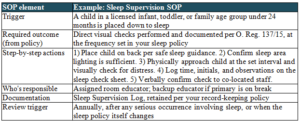
How to Write an SOP Staff Actually Follow
- Start from the regulatory outcome, not a blank page — identify exactly what the related policy requires before drafting steps.
- Write each SOP as numbered actions in the order staff perform them, not as a narrative description.
- Name who is responsible for each step, including a backup if the primary person is unavailable.
- State exactly what gets documented, on what form, and where that documentation is stored.
- Post high-frequency SOPs (diapering, handwashing, emergency response) physically where the task happens, not just in a binder.
- Set a review trigger — a fixed date, plus an automatic review after any related incident or serious occurrence.
- Walk every new hire through each SOP during onboarding, and have them demonstrate it before working unsupervised.
Common Mistakes That Undermine SOPs
- Writing SOPs as legal paraphrasing instead of action steps. Staff need “do this, then this,” not a restatement of the regulation.
- Keeping SOPs only in a digital file nobody opens. The most-used procedures need to be visible at the point of use.
- Never updating after an incident. A serious occurrence is exactly when an SOP should be reviewed and tightened, not filed away.
- Assuming experienced staff don’t need to follow the written version. Consistency breaks down fastest when tenured staff rely on memory instead of the current SOP.
- Treating SOP creation as a one-time project. Programs that grow or change rooms need their SOPs reviewed against the new layout and staffing, not left as-is.
When to Bring in a Daycare Consultant
Daycare consultant services are frequently engaged to translate mandatory licensing policies into actionable SOPs, particularly for operators navigating Ontario’s licensing requirements for the first time or formalizing routines before an inspection. An experienced consultant familiar with licensing for home daycare and centre-based programs alike can help identify where a policy exists on paper but the actual day-to-day procedure hasn’t been written down anywhere staff can reference it.
Key Takeaways
- A policy states the rule and why it exists; an SOP defines the exact steps staff follow to deliver it consistently.
- Ontario’s regulation often sets the required outcome and leaves specific procedures, like check frequency, to the licensee’s own written policy.
- Core SOPs should cover sleep supervision, diapering, safe arrival/departure, medication, allergy response, emergencies, serious occurrences, and sanitation.
- SOPs should be numbered action steps with a named responsible person, not a narrative restating policy language.
- Review SOPs on a set schedule and immediately after any related incident.
Conclusion
Strong SOPs are what keep a licensed daycare running the same way regardless of which staff member is on shift. Start with the policies your licence already requires, convert each one into clear numbered steps with a named owner, and post the ones staff use daily where they’ll actually see them. If you’re still working from policies that were never turned into real procedures, that gap is one of the highest-value places to bring in professional support before your next licensing review.